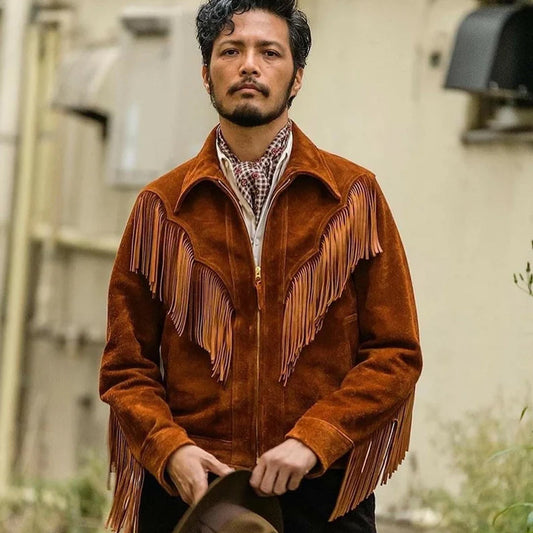
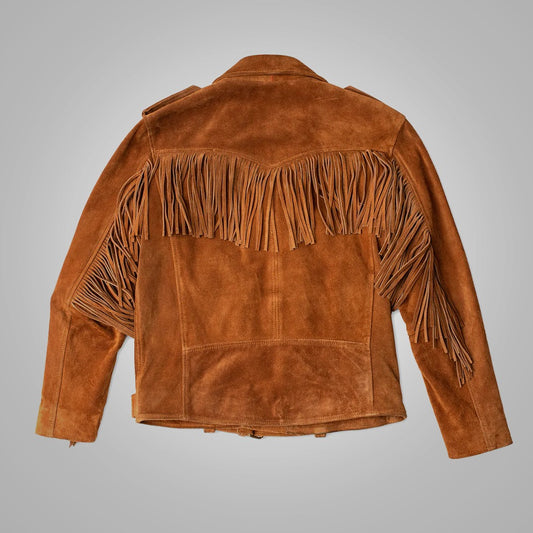
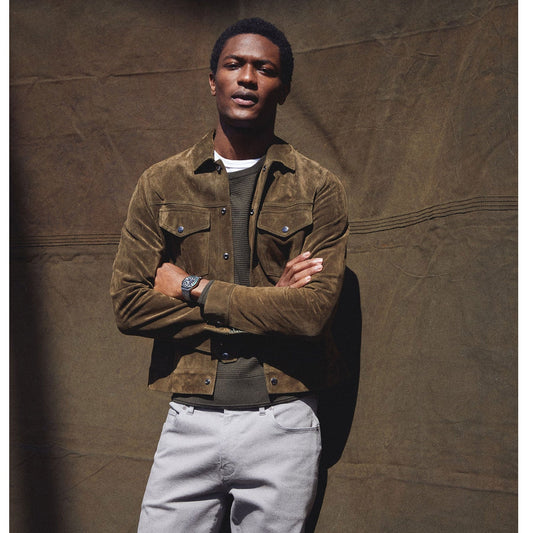
A men’s suede jacket has a character that smooth leather cannot quite reproduce. The softly brushed surface absorbs and reflects light differently across each panel, giving brown suede depth without relying on heavy distressing or decorative hardware. It feels relaxed enough for everyday clothing but remains more refined than a standard fabric jacket.
Our men’s suede jackets are made for dry, mild-to-cool days when a heavy winter coat would be unnecessary. The current collection includes brown goatskin suede styles with leather thicknesses of approximately 0.75 mm to 0.8 mm, practical pockets and reliable YKK zipper closures. Each design has its own construction, lining and pocket arrangement, so the individual product page should always be checked before choosing.
What Is Suede Leather?
Suede is genuine leather with a soft, fibrous surface called the nap. Instead of displaying the smooth outer grain associated with traditional leather jackets, suede is finished to reveal and refine a velvety surface.
The nap is what gives suede its distinctive touch and shaded appearance. When the fibres are brushed in different directions, the material can look lighter or darker even though the leather has not changed colour. This movement is a normal feature of real suede rather than a defect or uneven dye job.
The surface also explains why suede needs different care from smooth leather. A cream or conditioner intended for polished leather can flatten or darken the nap, while excessive water may leave visible marks. Suede should therefore be brushed and cleaned with products specifically intended for napped leather.
Why Goatskin Works Well for Suede Jackets
Goatskin is particularly suited to men’s suede jackets because it can be cut at a relatively light garment weight while retaining a useful amount of body. It is naturally flexible, making it comfortable for jackets that need to move through the shoulders, elbows and cuffs.
The current jackets in this collection use goatskin measuring approximately 0.75 mm to 0.8 mm. At this thickness, the leather can form defined collars, stitched panels and structured pockets without creating the bulk associated with heavy outerwear.
Goatskin also has a naturally fibrous structure that responds well to suede finishing. Once the surface has been buffed, the raised fibres create a soft nap with visible tonal variation. The result is a jacket that feels less formal than polished leather but more substantial than cotton, corduroy or synthetic suede.
As goatskin is a natural material, small variations in nap, shade and surface texture may appear between panels or individual jackets. Thoughtful cutting helps distribute those variations so the finished garment looks balanced rather than artificially uniform.
You can learn more about material selection, pattern cutting and reinforced construction on our page explaining how our leather jackets are made.
How Goatskin Becomes Suede
Raw goatskin must be converted into stable leather before it can be used for clothing. This is done through tanning, a controlled process that stabilises the skin’s collagen structure and prevents it from breaking down like untreated hide.
Before tanning, the skin is cleaned and prepared. After tanning, it can be dyed, conditioned, dried and adjusted to the required thickness. The suede surface is then created and refined by buffing the flesh side or prepared leather surface until a consistent nap develops.
The nap must be even enough to give the jacket a coherent appearance, but real suede will never look completely flat or mechanically identical. Differences in fibre direction are part of its appeal and are especially visible on brown and dark-brown suede.
Understanding the Tanning Method
Garment suede may be produced using chrome tanning, vegetable tanning or a chrome-free tanning system. These terms describe how the skin’s collagen structure is stabilised; they do not describe whether the visible surface is smooth or suede.
Chrome tanning is widely used for garment leather because it can produce soft, flexible leather with consistent colour. Vegetable tanning uses tannins derived from plant material and usually creates a firmer character. Chrome-free methods use other tanning agents and represent a separate technical category.
The exact tannage can vary according to the hide, colour, required handle and production batch. Unless an individual product specification explicitly identifies its tanning method, we do not describe every jacket in this collection as chrome-tanned, vegetable-tanned or chrome-free. This avoids making an unsupported material claim based only on appearance.
If a particular tanning method is important to you, please contact Leather Wear UK before ordering so the details of the selected jacket can be checked.
Two Different Approaches to Brown Suede
The collection brings together jackets that use the same broad material family but have noticeably different personalities.
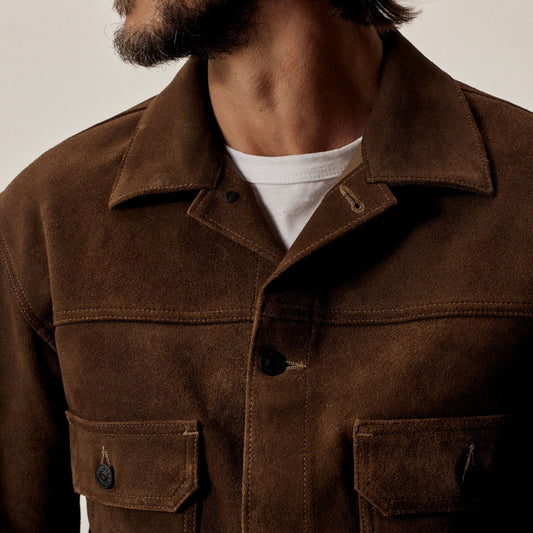
The men’s brown suede leather jacket takes the cleaner route. Its approximately 0.75 mm goatskin suede is cut with a pointed shirt collar, a shaped front yoke, a horizontal back yoke and a straight, unribbed hem. Tonal stitching keeps the panel work understated, while two outside pockets, one inside pocket and a standard YKK front zipper provide practical everyday function.
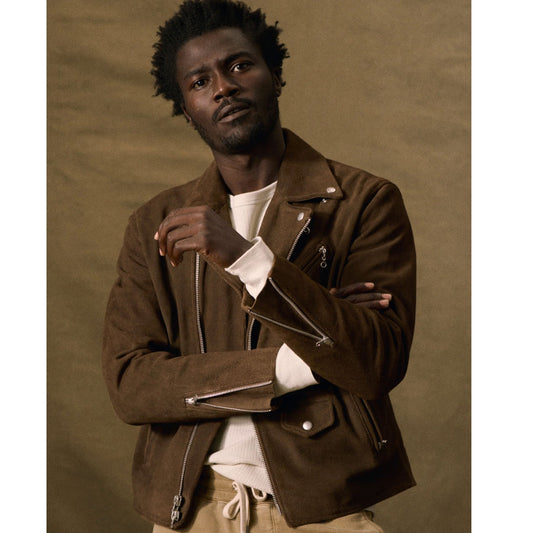
For a more rugged appearance, the men’s dark-brown goatskin leather jacket uses approximately 0.8 mm goatskin with visible contrast stitching and utility-inspired pocket construction. It has one chest pocket, two larger lower pockets and an additional internal pocket. Snap-fastened pocket flaps and a two-way YKK zipper give it the character of a traditional field or workwear jacket.
This difference matters when choosing. One style offers a minimal, modern silhouette; the other makes pockets, stitching and metal hardware part of the design.
Suede Jacket Construction
A good suede jacket depends on more than the softness of its outer material. The position of the seams, the direction of the nap and the alignment of the panels all influence how the finished jacket looks.
Large sections of suede can reflect light differently if adjacent panels are cut in opposing directions. Careful pattern placement helps maintain a more consistent flow through the front, back and sleeves. Natural variation will remain, but it should feel intentional.
Stress points such as pocket corners, cuffs, shoulders and zipper edges require secure stitching. Depending on the design, visible topstitching may blend with the suede or deliberately contrast against it. The minimalist brown jacket uses quieter tonal stitching, while the darker utility style uses more visible parallel stitch lines around the collar, pockets, yoke and hem.
Hardware also affects how the jacket performs. YKK zippers are used for dependable front closure, with either a conventional single-slider arrangement or a two-way design that can be released from the hem while remaining closed above.
Lining and Interior Comfort
Lining prevents the unfinished side of the leather from rubbing directly against clothing. It also helps the sleeves move more easily over shirts, T-shirts and light knitwear.
Lining materials differ between the jackets in this collection. One design uses a soft blend of 50% cotton, 30% polyester and 20% elastic, while the dark-brown utility jacket has a 100% polyester lining. These linings create different interior feels, so consult the individual description rather than assuming every suede jacket uses the same fabric.
The lining should not be confused with thermal insulation. These are leather fashion and everyday outerwear pieces, not padded winter coats.
When to Wear a Men’s Suede Jacket
These jackets are intended primarily for dry weather from approximately 5°C to 15°C, depending on the individual design. The 0.75 mm jacket can cover a wider mild-weather range, while the slightly heavier 0.8 mm style is recommended around 5°C to 10°C.
Temperature guidance is necessarily approximate. Comfort depends on the clothing worn underneath, activity level, wind, humidity and personal tolerance of cold. A suede jacket over a T-shirt may work on a mild afternoon, while a shirt or fine jumper provides additional warmth as temperatures fall.
These jackets are not waterproof and should not be worn as rainwear. They are also not windproof, as their collars, cuffs, pockets and zippers are not sealed like those on technical outdoor clothing.
For genuinely cold conditions, explore our more heavily insulated men’s shearling jackets.
Suede Versus Smooth Leather
The choice between suede and smooth leather is mainly about texture, appearance and the conditions in which the jacket will be worn.
Suede has a soft nap and a low-shine finish. It tends to look relaxed and develops subtle tonal movement as it is worn. Smooth leather has a visible outer grain, usually offers more surface protection and can generally be wiped more easily.
A suede jacket is a strong choice for dry days and softer outfits. Smooth leather may be preferable when you want a sharper finish or something easier to maintain in changeable conditions. If you like the same earthy colour palette but prefer a smooth, waxed or distressed grain, browse our wider selection of men’s brown leather jackets.
Choosing the Right Size
Suede can become more comfortable with wear, but buyers should not rely on it stretching enough to correct a jacket that is too small. The shoulders should sit correctly from the beginning, the sleeves should reach the wrist, and the zipper should close without pulling across the chest.
Consider what you intend to wear underneath. Choose a closer fit if the jacket will normally be worn over a T-shirt. Allow more room if you expect to layer it over shirts or knitwear.
Before ordering, compare your measurements with our leather jacket size guide.
How to Care for Goatskin Suede
Regular, gentle care is more effective than waiting until the suede becomes heavily marked.
-
Keep the jacket away from prolonged rain and standing water.
-
Allow damp suede to dry naturally at room temperature.
-
Never dry it directly against a radiator or with concentrated heat.
-
Use a clean suede brush to lift the nap and remove loose surface dust.
-
Brush gently in a consistent direction rather than scrubbing one area.
-
Do not apply ordinary smooth-leather cream, oil or wax to suede.
-
Test any suede protector on a hidden area because it may alter the shade.
-
Store the jacket on a broad hanger to support the shoulders.
-
Use a breathable garment cover rather than sealed plastic.
-
For deep stains, consult a cleaner experienced with suede garments.
A Softer Alternative to Heavy Leather Outerwear
Men’s goatskin suede jackets occupy a useful space between lightweight fabric jackets and heavily insulated leather coats. They provide the natural texture and structure of leather while remaining suitable for everyday, mild-weather layering.
The material is not maintenance-free, waterproof or designed for extreme cold. Its appeal comes from somewhere else: a soft hand, a distinctive matte finish and the way each panel responds to wear and light over time. Choose the design that suits your preferred pocket layout and styling, check its individual material details, and give the suede the dry-weather care it requires.